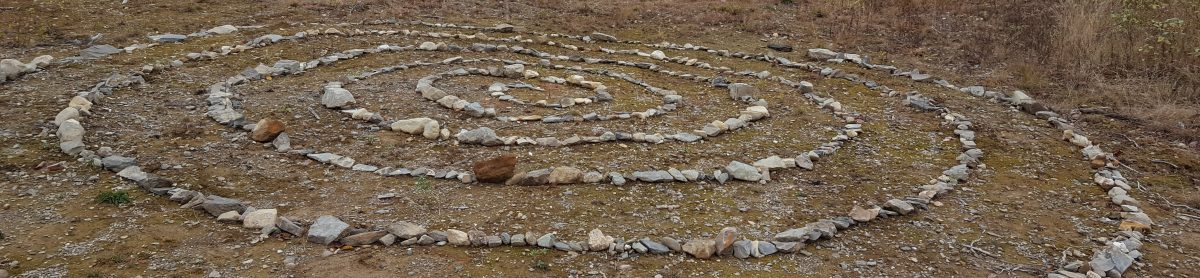
Ekphrastic Writing

One of the ways that I am finding sanity in an ever chaotic world is to participate in a local writing group. Although my purpose of this site is to share with you my liturgical writing, the site is called Wandering and Wondering, so join my in a little diversion.

Here are 5 Ekphrastic writing pieces. Ekphrastic writing as it was introduced to us is using a picture or other non-literary piece as a jumping off piece for our writing. This is the site that the leader of the group this month cited to help us understand what was expected.

Here are my experiments in this writing style:

#1

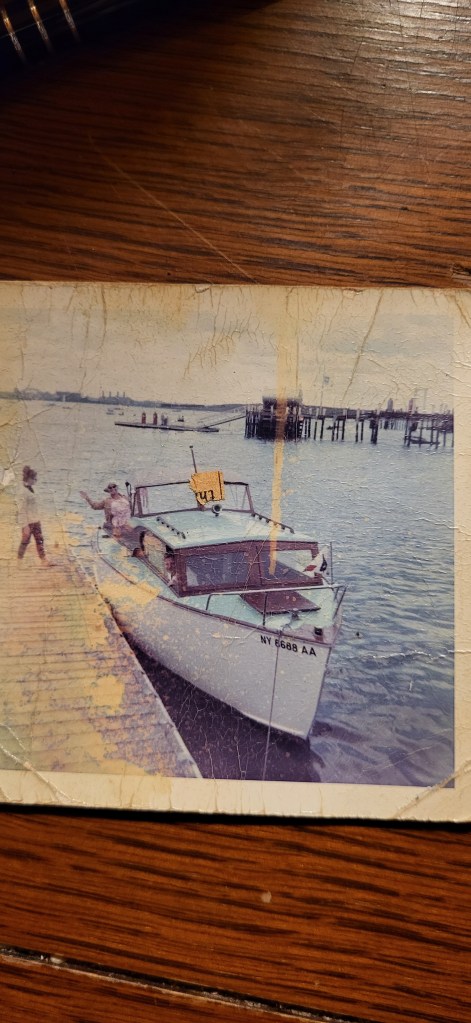
A memory not mine
By dawn m. adams

In amongst the pages
was a memory before my time
of a boat upon the ocean
that in my lifetime only sat on cinderblocks
growing weeds and harboring wasps.

The photo, though, is of a life before the time of kids, responsibilities, and bills.

The photo’s bent and crackling face give testimony to its ages
as it tries unsuccessfully to hold its color –
mustard yellow-brown blotches overtaking the dock and threatening the people in its frame.
My mother walks on the dock, approaching the teal topped wooden cabin cruiser.
A smiling stranger puts out a hand to her
and another pears out the captain’s window.
It seems that all but she knows they are being photographed.

Is it my father taking the still? He is nowhere in sight.

The sea is calm and the boat only gently rocks
as it waits tethered to the dock for its passengers.

Atop the boat, likely stuck by accident, is a fragment of upside-down “th” sticker
From another long-lost memory, trying to tell its own story.

#2

The Mustard Seed Retold

By Dawn M. Adams

A single seed suffers in the ground
like the pearl of great price, its value is beyond compare.
Down its roots burrow,
and up its branches grow.
For such a small dull seed, it flourishes
above the ground into a bush flush with
yellow flowers:
each branch a home to another species of bird.

What a racket must come from that bush:
chickadee,
heron,
thrush,
and raven;
swallow,
cardinal,
orange tanager,
and jay.

They make their home within the mustard bush,
taking refuge from the harsh world.
Together creating a brash combination of
yellow,
green,
tangerine,
and blue.

Every hue and every caw testifying
To the power and wonder of
a single seed willing to
grow in a harrowing world .

If you would like to see the picture from which it was inspired, visit Kelly Latimore’s page.


#3

A Mother’s Lament

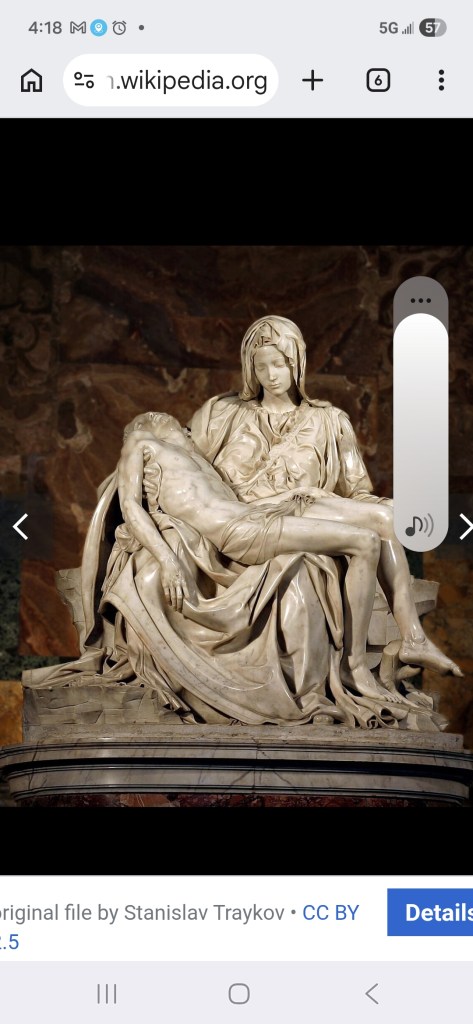
  • A response to Michelangelo’s Pieta

By Dawn M. Adams

How?

How could it come to this?

I said, “Yes!”

I carried you within me.

I birthed you.

Was it all for naught?

                Would God be so cruel?

I hold you now –

                your body ravaged and worn.

What I would give to bring you back.

I hear them singing, “Where you there?”

                and my tears cry out, “I was. I am. Where were you?”

I hold him hoping for another miracle, hoping he will awaken,

                                                                                but knowing he will not.

I wish I could will him back into my body

                so that such suffering might end.

He is a man

And yet,

Text Box:  he is my son.

I cannot bring myself to let him go.

I will not let go.

I will hold him in my arms forever.

My son,

                My son,

                                May you rest.

                                                Your mother is here.

#4

The Eye

By Dawn M. Adams

I draw myself one stroke at a time.

I do not wish to go outside the lines.

I mix the colors o’ so carefully

                trying to be true.

Can they see through? Behind the mask?

Is the trembling of my hand visible

                to the trained eye?

It is strange to have such power to

                create how the world sees me. I’m not

                sure if it is a privilege or a curse.

I am not God.  What do I know really?

Some days I’m tempted to start all over again.

Maybe I’m just too close to the subject to

                                                                be objective.

What do you see?

                Do you see the true me?

                                or the me I want you to see?

Do you care if there is a difference?

This picture I found at: https://www.southwales.ac.uk/study/subjects/art-and-creative-wellbeing/


#5 and final

I so wish they’d stop fighting.  They both say they love me and yet they will not stop.  Don’t they know what such hostility does to a young heart?

I sit here waiting and watching, wishing I was somewhere else, anywhere else.

The whole thing makes me tired.  They toss me back and forth like a prized football – not realizing that in the tossing that I am getting scuffed and bruised.

Mom made me dress in my Sunday best and even put a red ribbon in my hair.  I think she wanted dad to think everything was normal at home without him, that we were getting along just fine without him; but there are days mom doesn’t even get out of bed.  Days that I have to try to figure out what to make for dinner – – – Did you know that fried bologna can be pretty good when put on Wonder bread with a squeeze of ketchup?

If they keep fighting like this I may as well just put on my jacket and disappear.  I wonder if they’d even notice that I left. 

I bet mom would leave thinking I went upstairs to my room ; and I bet dad would think she dragged me back home with her. 

How long do you think it would be before they realized that I was with neither of them, but instead out in the world hoping to find a rainbow in the storm.
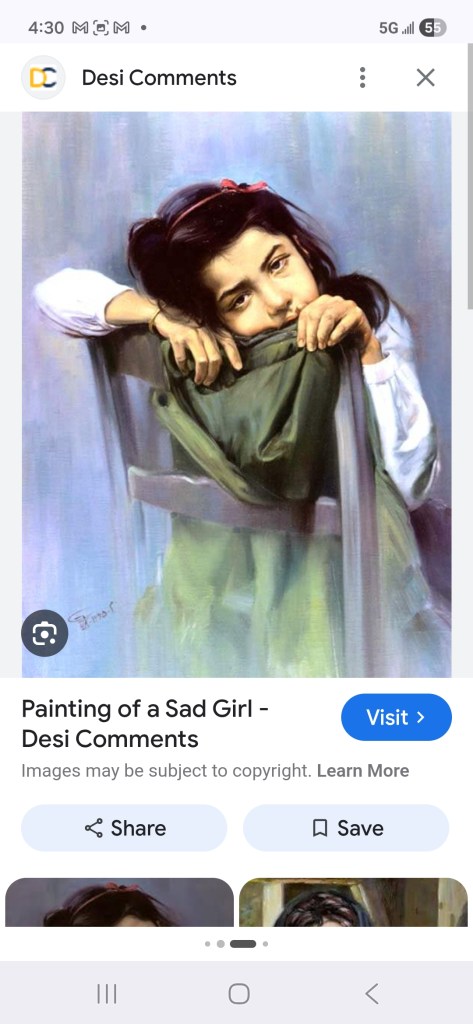
I am unclear who to attribute this painting to as it seems to have many attributions on the web.


I would love to read your version of a Ekphrastic writing. Please feel free to post or link your work below.

NOTE: All rights reserved for the works above. It you would like to use, please contact me with purpose and usage proposal.

Mid-week meditation – Literary Version

Here is a fun and interesting writing prompt that you can take into any book or character in the Bible. Frankly, you can use it in secular ways as well.

  1. Take a word – Book of the Bible, Character, Value. I suppose even a short verse.
  2. Write it vertically like you want to create an acrostic poem
  3. Then write a story / poem being sure to include words that begin with those letters.

This is a fun and interesting way to engage with the text.

Here is an example of one that I wrote for Genesis (specifically Genesis 1:1-2)

Generally, in the beginning, we believe, is where things started, but our beginning begins in the deep. A deep that

Existed before time: a place of void and darkness, but also of possibility and

Newness.  Nothingness is not nothingness if it is describable, if it is navigable, if it

Exists. So what was before there was? What was this vast

Sea that the wind blew on? How was it born? How did it begin? Was there something before that melted

Into the primordial soup? Or was this the beginning of God’s

Soup recipe?  Set one part chaos to simmer.  Stir lightly with the movement of the Spirit.  Wait. Watch. And voila– Life!

All Rights Reserved. Permission to used in educational or religious settings with citation.

Using Words and Style as a Writing Prompt

This week in mid-week meditation, I offered two prompts based on the same poems. I randomly picked poems and then asked AI to remove punctuation and capitalization and randomize the words. The first prompt invited the writers to write using the words before them as a base.

For Example, here were my words:

films intentionally loving of the their feet while art culture borders hesitation possibilities fire paint artists loud or wall see and creative canvas kind-based canvas directed sprinting mumblings conscience limitations and all us deliberately windstorms blast motivation into with quality do art their struggle quiet questions without run does to and with move people or intentionally paint and has loving and and life-centered does toward can’t doubts with cameras name has create misrepresentations has blasts gates culture ideas advance and see a world centered civilization and and and the talk and struggle move escape and searching not and good or feet questionably questionably phones gates has ideas doubts the loving own toward move fire justice of people their advance loving art themselves has of not people computers its civilization paint forward clear canvas intentions blasts daily and pen paper question run run or walls feet as mumblings based with community run paint souls good rulers with and name quietly paint searching artists and loving has definitions and has gatekeepers and daily windstorms loving loving canvas with toward and and paint the

I gave us 15 minutes, this is what I wrote:

Untitled

To intentionally paint the world with love creates life.

There are no limitations

Civilization tries to rule

setting borders

and erecting walls.

It misrepresents truth

and sews doubts,

leaving society lost and lonely.

Daily windstorms tattering the art

that has so lovingly been created.

But the art of love

offers possibilities beyond the gates culture has created.

Love offers justice

it leans in with questions

and listens.

It paints quietly, slowly, subtly,

and brashly, without hesitation using bold strokes.

There are no gate keepers here

simply lovers loving:

a world searching for good,

souls seeking and searching

for new canvases on which to

paint beauty and possibility.

Then, I offered them the opportunity to read the actual poem. Mine was Art IV: Remembering Gwendolyn Brooks by Haki R. Madhubuti.

We then took an additional 10 minutes to write a poem based on the style they noticed in the poem. This is what I created:

Remembering Ezekiel Kallberg

children are fed what we feed them

they cannot forge on their own.

they are reliant on what we bring – good or bad.

children not only fill themselves

with the nutrients we provide;

But also the love, the wonder,

the hope, the resilience we fill them with

children absorb our ways

without us ever needing to

speak and perhaps even

before their ears can hear

outside the womb.

what shall we offer this

hungry one – ancient

dusty artifacts, a diet of anger

and war, a meal made

of mush,

or shall we choose to gather

them in our lap and blanket

them in love,

shall we surround them with

support and welcome them

into wonder.

shall we put before them a

feast which tantalizes them

and invites them to taste,

touch, sample

and decide for themselves

their favorites.

and perhaps even one day

teach them to cook.

Neither of these are perfect poems, but the process is like putting compost around your garden. The nutrients seep in and before you know fruit is produced.

I encourage you to give it a try and see what your process might seed.

All Rights reserved. For permission to use, please send me a quick email to explain how you would like to use this process or product.