Using Words and Style as a Writing Prompt

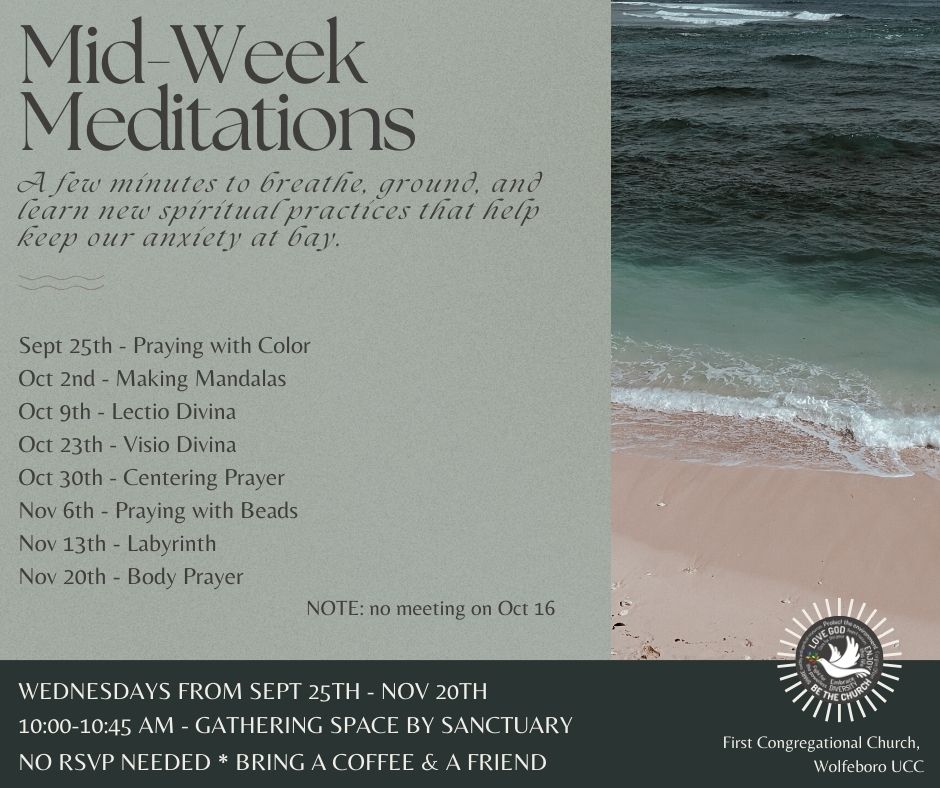
This week in mid-week meditation, I offered two prompts based on the same poems. I randomly picked poems and then asked AI to remove punctuation and capitalization and randomize the words. The first prompt invited the writers to write using the words before them as a base.

For Example, here were my words:

films intentionally loving of the their feet while art culture borders hesitation possibilities fire paint artists loud or wall see and creative canvas kind-based canvas directed sprinting mumblings conscience limitations and all us deliberately windstorms blast motivation into with quality do art their struggle quiet questions without run does to and with move people or intentionally paint and has loving and and life-centered does toward can’t doubts with cameras name has create misrepresentations has blasts gates culture ideas advance and see a world centered civilization and and and the talk and struggle move escape and searching not and good or feet questionably questionably phones gates has ideas doubts the loving own toward move fire justice of people their advance loving art themselves has of not people computers its civilization paint forward clear canvas intentions blasts daily and pen paper question run run or walls feet as mumblings based with community run paint souls good rulers with and name quietly paint searching artists and loving has definitions and has gatekeepers and daily windstorms loving loving canvas with toward and and paint the

I gave us 15 minutes, this is what I wrote:

Untitled

To intentionally paint the world with love creates life.

There are no limitations

Civilization tries to rule

setting borders

and erecting walls.

It misrepresents truth

and sews doubts,

leaving society lost and lonely.

Daily windstorms tattering the art

that has so lovingly been created.

But the art of love

offers possibilities beyond the gates culture has created.

Love offers justice

it leans in with questions

and listens.

It paints quietly, slowly, subtly,

and brashly, without hesitation using bold strokes.

There are no gate keepers here

simply lovers loving:

a world searching for good,

souls seeking and searching

for new canvases on which to

paint beauty and possibility.

Then, I offered them the opportunity to read the actual poem. Mine was Art IV: Remembering Gwendolyn Brooks by Haki R. Madhubuti.

We then took an additional 10 minutes to write a poem based on the style they noticed in the poem. This is what I created:

Remembering Ezekiel Kallberg

children are fed what we feed them

they cannot forge on their own.

they are reliant on what we bring – good or bad.

children not only fill themselves

with the nutrients we provide;

But also the love, the wonder,

the hope, the resilience we fill them with

children absorb our ways

without us ever needing to

speak and perhaps even

before their ears can hear

outside the womb.

what shall we offer this

hungry one – ancient

dusty artifacts, a diet of anger

and war, a meal made

of mush,

or shall we choose to gather

them in our lap and blanket

them in love,

shall we surround them with

support and welcome them

into wonder.

shall we put before them a

feast which tantalizes them

and invites them to taste,

touch, sample

and decide for themselves

their favorites.

and perhaps even one day

teach them to cook.

Neither of these are perfect poems, but the process is like putting compost around your garden. The nutrients seep in and before you know fruit is produced.

I encourage you to give it a try and see what your process might seed.

All Rights reserved. For permission to use, please send me a quick email to explain how you would like to use this process or product.
Impermanence

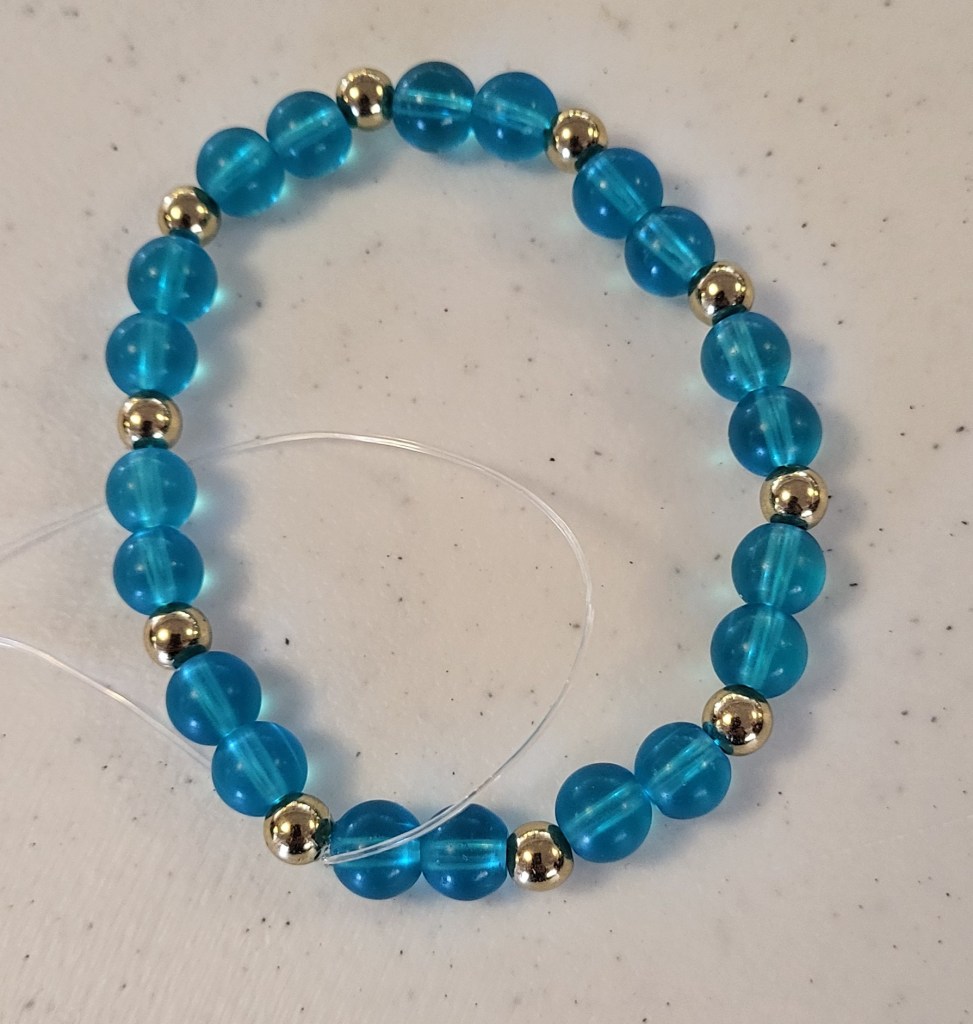
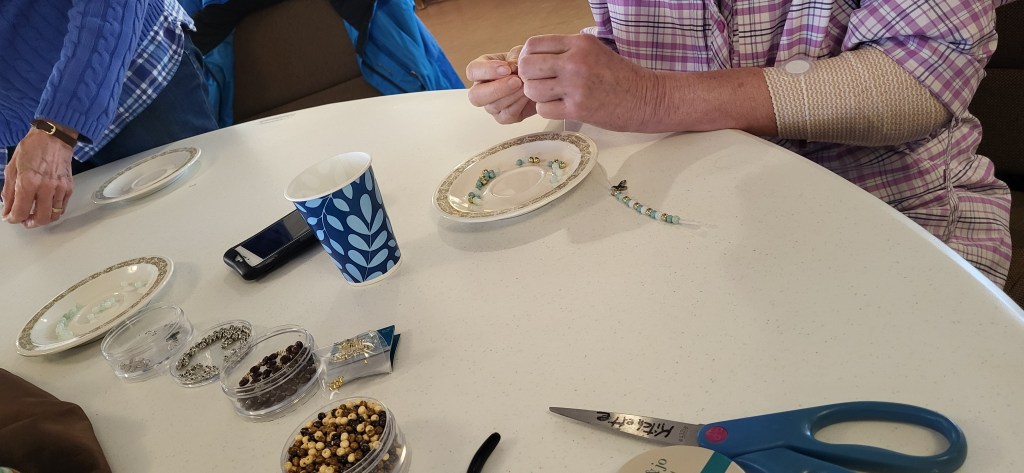
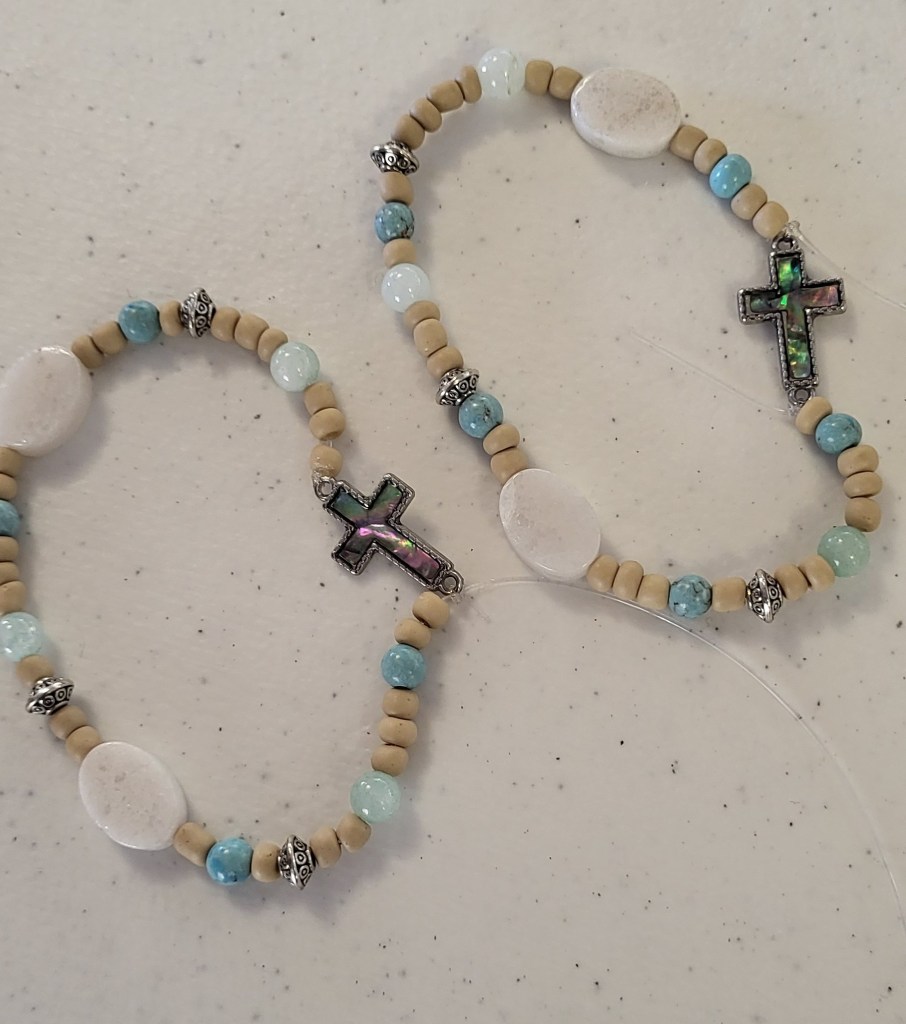
Today in our mid-week meditation group we made prayer bracelets.

The process was gift and the reminder I found in prepping for the class was worthy.

A while ago, I found this book “A String and A Prayer” on my bookshelf and began reading it in preparation for this class. I used some of the prayers in the back as our opening and shared some of its insights during our class:

-The word bead is an offshoot from its Old English origin “bede” which means prayer.

-In Sanskrit the name of a pray bead chain is called a mala.

-That the practice of putting together prayer beads can be a spiritually significant as the practice of praying with them.

-It is said the the Desert Mothers and Fathers would carry a specified number of beads in their pockets with they would drop to the earth throughout the course of their day as they prayed.

And then finally –

-All prayer bead jewelry will eventually fall apart.

This final one sounds depressing, but it is real. It perhaps struck me especially funny because at our our last confirmation meeting when we created the Protestant equivalent to prayer bead rosaries (which by the way are named such because the beads were apparently made out of crushed rose petals) we worked very hard at crimping and trying to secure our creations so that they would be indestructible. Impermanence is not something that we like to think about much. In Christianity, with the exception of Ash Wednesday and perhaps Good Friday, we have a tendency to focus on the eternal and ever-lasting, brushing aside the reality that life here is guaranteed to end. Perhaps though, the reality of our relatively short mortals lives and the reality of our impermanence might be a gift that might allow us to more fully stop and take in the world around us, celebrating the beauty and appreciating the relationships. Recognizing our impermanence may not be a morbid thought that freezes us in fear, but instead a freeing realization that allows us to better notice the many blessings that abound.

Whether or not you choose to create a prayer bracelet yourself, I hope that you might ponder their impermanence and yours as well. Your life may be all the richer having done so.


A Prayer of Gratitude for the Limitedness of our Lives

Holy One,

We are thankful for this time you have granted us on earth. Let us not waste it, nor take it for granted. Let us have clear view of its limits that we might be all the more thankful for the time we have. Grant us the insight that each breath we take is a blessing.

And when at last our time is short and we can feel the true fragility of life coming our way, let us be able to say that we were thankful for the opportunity, that we were thankful for the friends that we met, and that we were thankful for the time we had.

We give you thanks for each breath, each moment, and for our very life however long or short it might be. AMEN


NOTE: All rights reserved. Permission of use of the prayer in a worship or educational setting with citation.

Blessed to be a blessing

“I will make you into a great nation,
    and I will bless you;
I will make your name great,
    and you will be a blessing.
I will bless those who bless you,
    and whoever curses you I will curse;
and all peoples on earth
    will be blessed through you.” – Genesis 12:2-3

Can you imagine a world where we walked around consciously blessing one another and the world around us? Might this simple act deflate the tensions and anxiety that pervade our society. Could you imagine if we sought to find the holy chard (tikkun olam) that everyone and everything contained? or sought the holy fingerprint of the potter himself (Isaiah 64:8)?

What would it mean to begin to see the world as holy, to act as if it were, and to encourage it to be so? The act of blessings is an ancient practice that perhaps we should reinstitute. Doing so does not require an act of congress, nor a majority vote, it simply means that you and I make it so. Maybe, if we are lucky, the practice will grow.

Step one is simply to look with new eyes and see the beauty before us (Remember beauty is not always external; and beauty is not always what society names it to be.).

Step two is to name what you see or what you hope to see. If I were blessing my fireplace this morning, I might offer a blessing for the many days of warmth that it has brought to my house allowing me to be comfortable and to invite friends and family within. If I were blessing a person, I might offer a hope, “May this new year offer you opportunity and growth. May you find your footing, feel your strength, and be granted the courage to live fully into who you were meant to be.”

Step three is to share your blessing. You may say it quietly to God, say it aloud to the another person, or maybe take a moment to drop a note or a text to let them know that you are thinking about them. You might even post it on social media.

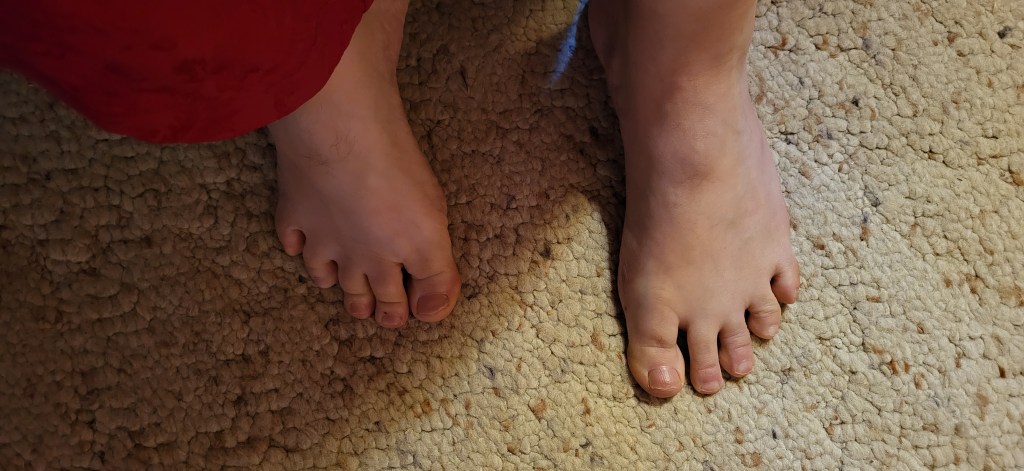
Blessings can also be done quietly within your heart as a prayer to God. I started to bless my feet in the morning after my mother passed away. She had thrown blood clots in her legs which subsequently caused an unhealing foot wound and caused the loss of several toes. My kids even were known to refer to her as Grandma Boo Boo Foot because, in their memory, she could never wear two shoes and usually need the assistance of a wheelchair. So now when my feet hit the floor I try to remember that even getting up in the morning and standing is not a blessing that everyone is afforded.

A Blessing for Feet

I wiggle them awake

and say, “Thank you!”

I touch them to the ground

and say, “Thank you!”

I press my weight upon them

and say, “Thank you!”

“Thank you little toes

and feet

and ankles.

Thank you phalanges

and metatarsals

and navicular bone.

Thank you to my muscles

and my tendons

and all the nerves

that go into each step I take.

Thank you God for my feet.

Bless them as they carry me through my day.

AMEN

NOTE: All rights are reserved for this blessing or anything published on this page. Permission is given for usage in religious or educational settings with citation.


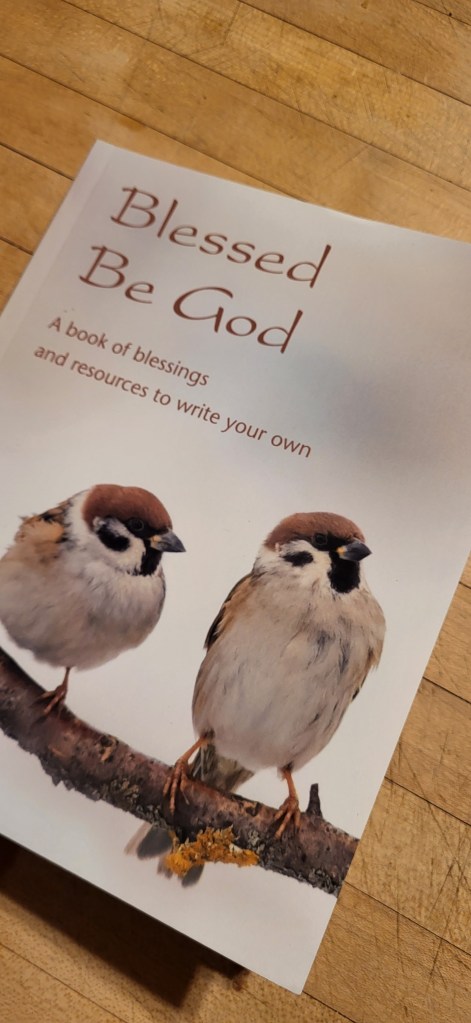
If you would like to read some more blessings including two of my own, check out Ruth Burgess’ book from Wild Goose Publications, Blessed Be God:

It takes a long time to create Bethlehem

This week’s mid-week meditation led to a powerful insight:

it takes a long time to create Bethlehem.

There is so much going on in the world, it came seem like a frivolous waste to gather and simply create art, but I have found this creative time to, in fact, be more important than ever. It is in these peaceful settings that we can take a moment to take stock of all that we have seen and heard and begin to try to understand our place and our calling within it all.

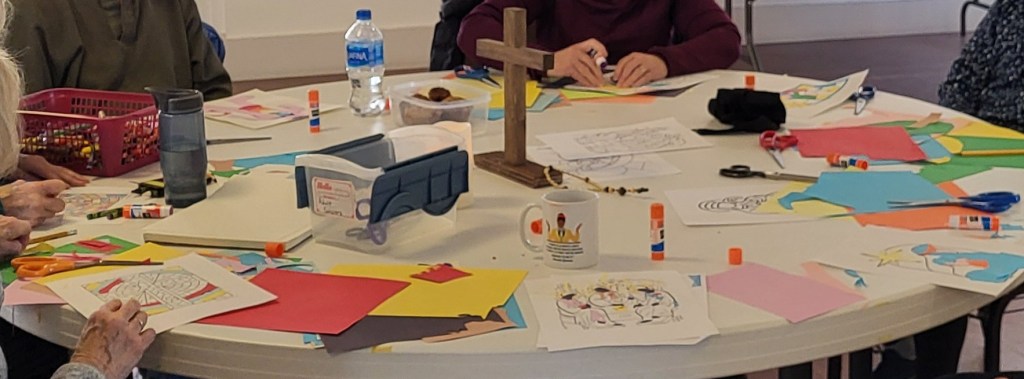
This week, when we gathered, our theme was mosaics. Given our time frame, we created our mosaics with paper, and I limited our paper to just solid colors. I offered the option of some pre-drawn blackline masters that I gathered from the internet and also had plain paper available. I tried to give people as little direction as possible because, like in each of our other weeks, the purpose is the reflection on our thoughts and the process more than the product that is produced.

People always find our time too short and these activities could easily be done on retreat in multi-hour blocks.

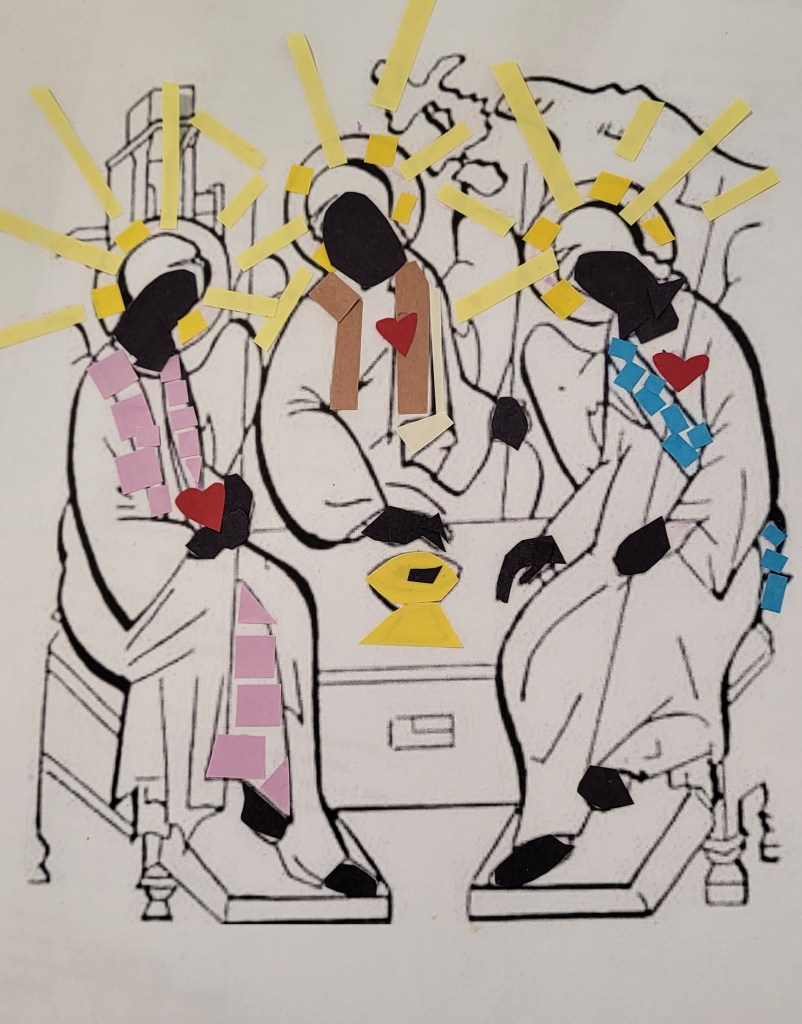
This was my creation based on Rublev’s picture of The Trinity. I was really caught by the idea that each of us have the capacity to be part of the trinity; thus the non-identification of the personalities. I also recognized how we need to be mindful of how we interact with one another. Even with our best intentions we sometimes press into each other’s space.

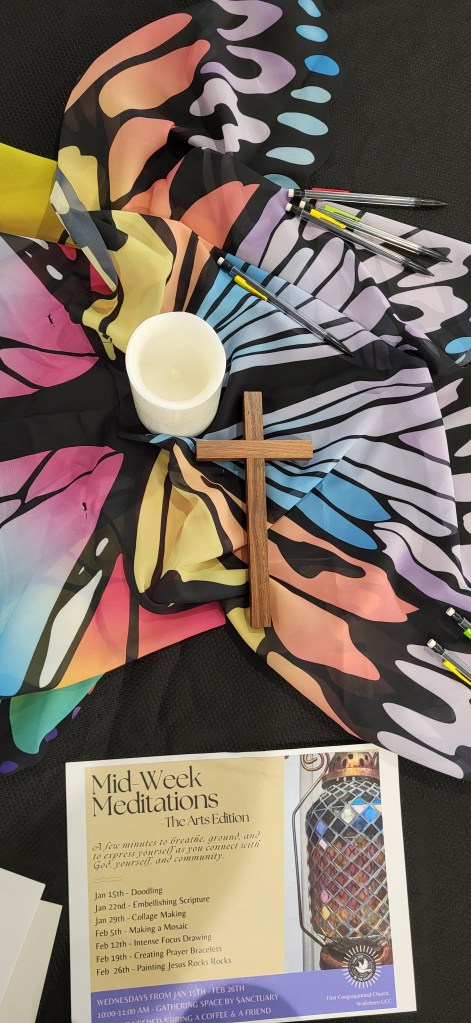
To help us be in the right mindset to create, we began our time together by putting our hands in the form of a bowl and filling our bowls with all the dread, frustration, anger, and worry that we brought in with us. After gathering it together in our own imaginary bowls, we placed the bowls below the cross in the center of the table and agreed that if stressful thoughts came our way we would give them over God through a symbolic gesture of hanging our worry on the cross. Once we released the troubles we came in with, we offered a prayer and lit our candle. Then I read a poem called Mosaic by Lily Whitelock (click here to read the whole poem) and offered a quote by Anita Krizzan. We were particularly enamored with the words of Lily’s third verse,

“Every word I know somebody else has told me.

Every smile I give someone else has shared.”

“We are mosaics. Pieces of light, love, history stars . . .Glued together with magic and music and words.

Anita Krizzan

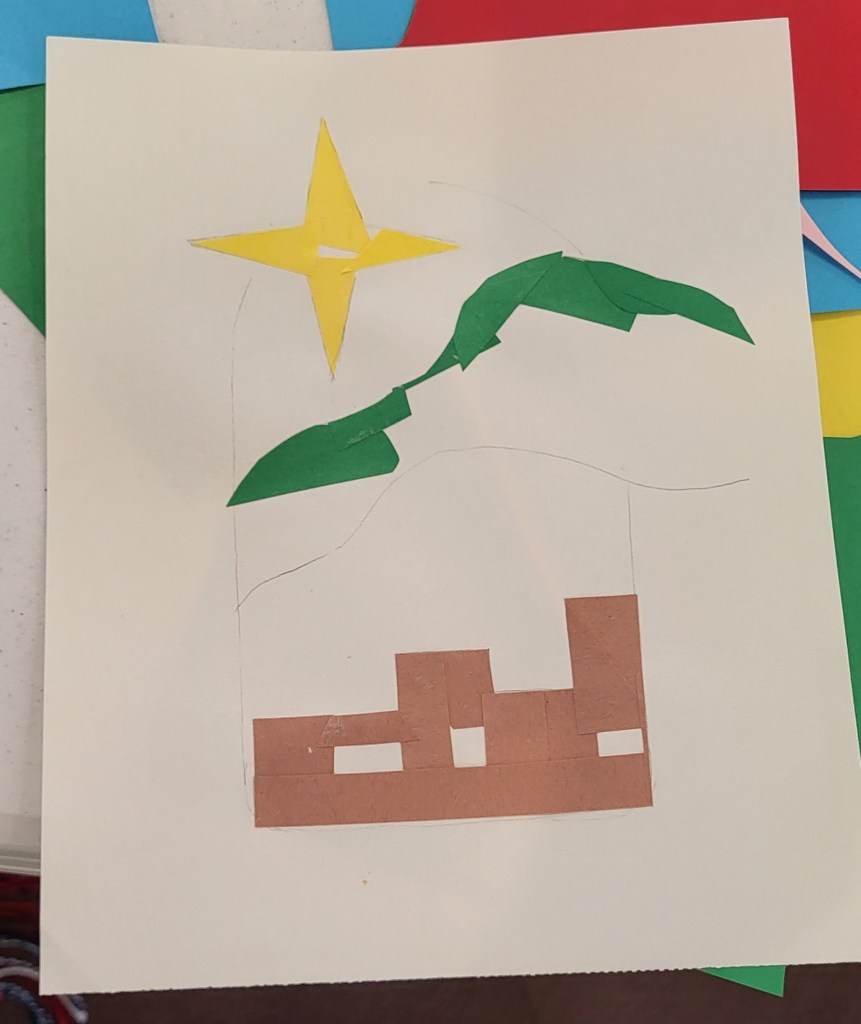
We then created for half an hour, gathering back together to discuss and reflect on the process. There were many insights that individuals had about how they created, what they created, why they created; and there was one that took all our breath away. As one congregant shared this work:

She explained that she didn’t have enough time and would be taking this home to finish. She somewhat flippantly said,

“If you didn’t know, it takes a long time to create Bethlehem.” MC

When she said that, my heart stopped. It was a reminder to us all that within the struggle and frustration that we are all feeling these day, we need to remember that to create takes time, energy, perseverance, patience, and vision especially when your vision is as complicated and simplistic as love, justice, and compassion.

We closed with a simple prayer and all went out into the world with a little more hope and with clearer understandings of where we might fit into the larger picture and how our gifts and talents might be used.

If you decide to try to create, I’d love to see what you make. Please post in the comments.

Holy One, Sometimes challenge comes not in complexity but in simplicity. As your co-creators in life, help us to step back and take stock on that which is essential. Encourage us to release that which gets in the way of your vision of heaven on earth being made real in the world. Call us into partnership with you so that together we might together create a peaceful, loving, and just world. Remind us of the time when your son was born in a simple stable. Let us remember its simplicity and yet also his power to transform the world. May you use us to do the same way. AMEN

Sacred Noticing

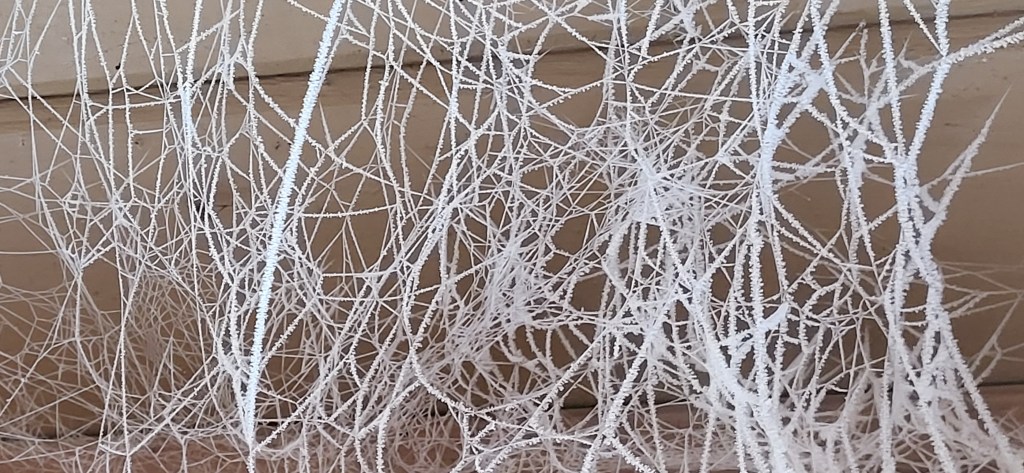
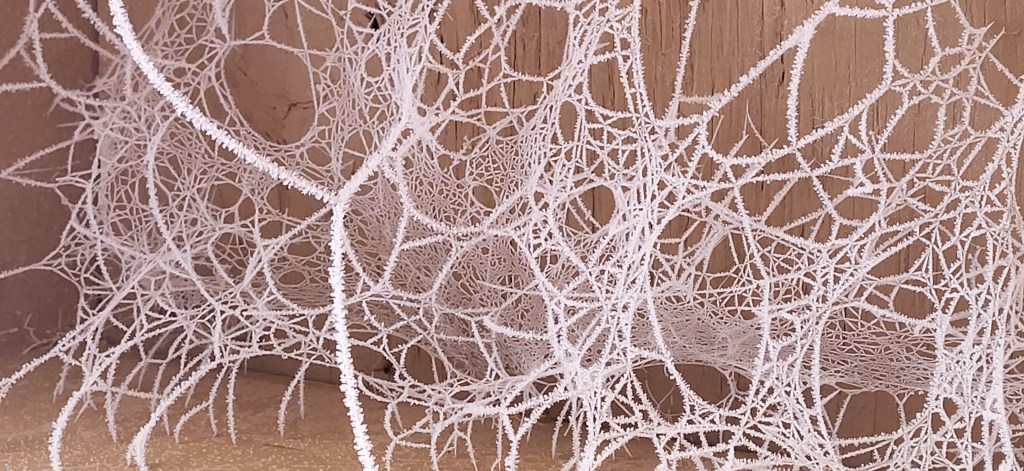
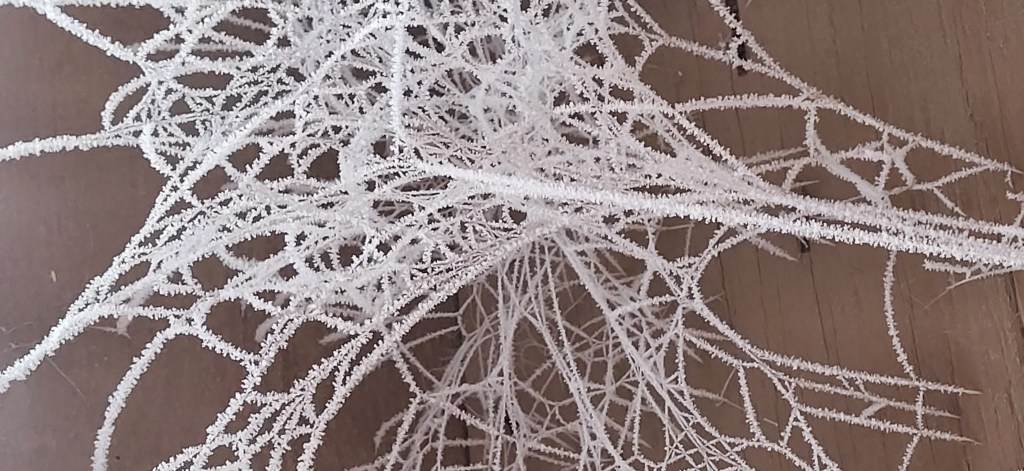
Yesterday, as I was preparing to leave for church, I looked out our backdoor to the lake and there I saw the beauty of creation in a way I had never seen it before.

I think it was a rare confluence of events that made it so. In the eves of the overhang to the porch were these fragile ice crystal cobwebs. They were invisible to the naked eye normally (not that we’ve been doing a whole lot of outdoor sitting these days in -6 degrees), but the kerosene heater with an outdoor vent had come on. It was very cold, and the eves caught the moisture.

Every moisture molecule that landed on the spider’s web froze immediately creating this crystalline creation. Each layer upon layer brought forward and made visible the beauty of the underlying design. It is surely a wonder to behold – similar to dew captured on a web as it glints in the sunlight. Part of the wonder in both of these situations is its impermanence. It was there in this moment, but within a few hours they were invisible again. It was a deep reminder to pay attention – deep attention.

When we think of prayer, we often think of words that we say out into the world, but perhaps we should expand our understanding to include that which enters into us as well. Perhaps our prayer is that moment when our breath is caught and all we can utter are syllables: “ahh”, “ohh”, “wow”.

Sacred noticing is a spiritual practice to always be on the look out for wonder and to be willing to pause the rest of the world so that you can fully take it in.

In this case, I called my husband over to behold it with me and he too offered the sacred prayer of “Wow! That is amazing.”


What have you seen today that has taken your breath away?

Illuminating the Word

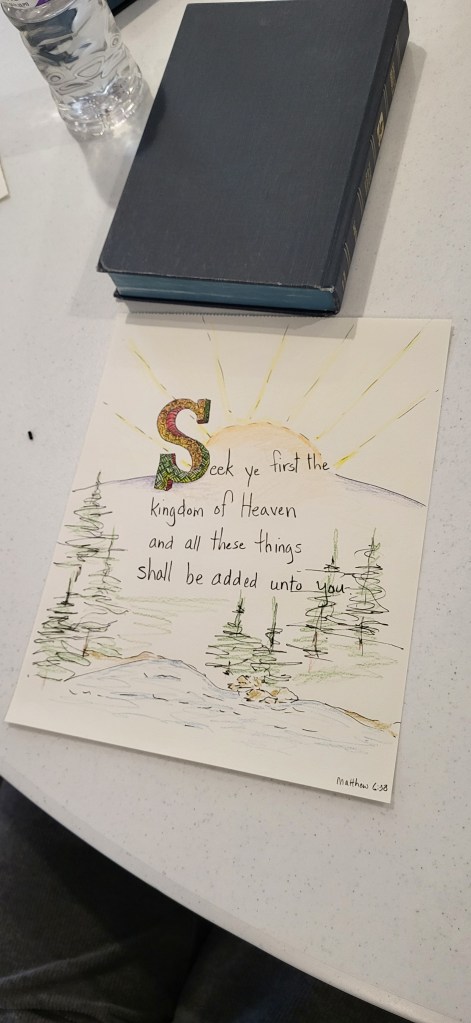
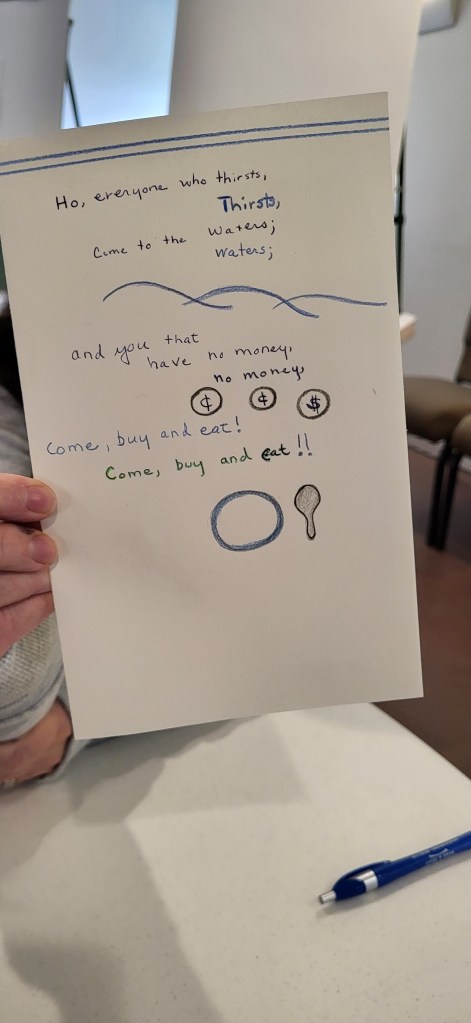
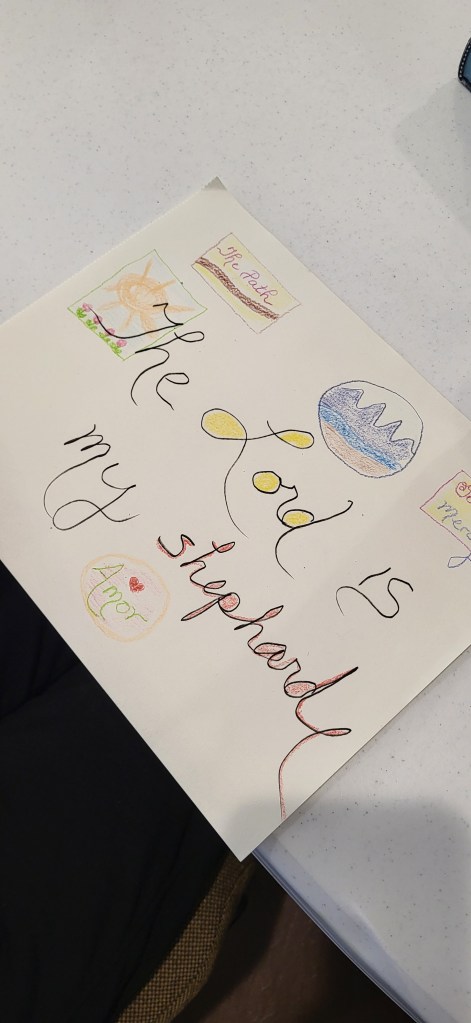
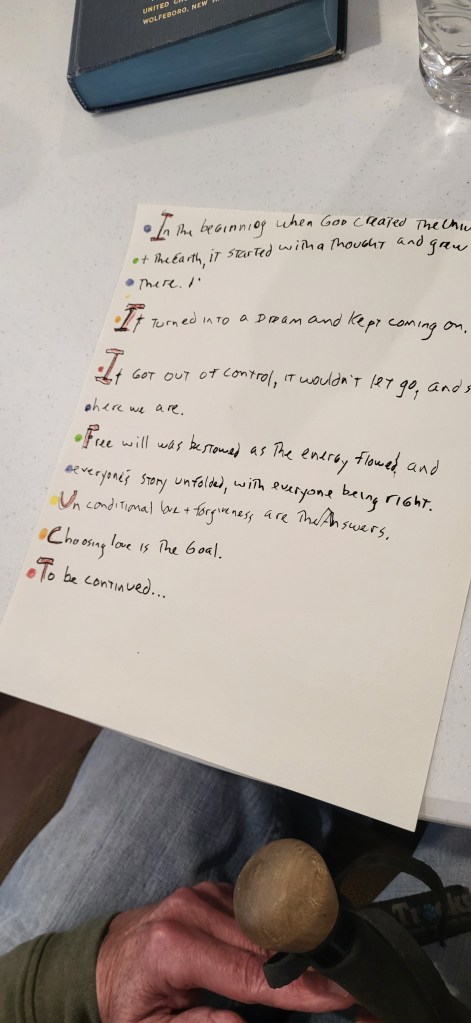
At this week’s mid-week meditation we explored the idea of Illuminating the Word: an ancient practice of embellishing our sacred scripture with drawings and designs. (A great article on the history of Biblical Illumination can be found here.)

First, we explored what has been done historically and then we engaged with the process. As we were not actually hand writing the entire Bible and only had an hour for our process, we chose single verses to illuminate. I had brought a scripture coloring book which had some scriptures pre-chosen and printed for anyone who was uncomfortable picking a text, but interestingly everyone opted to chose and write their own.

I shared with them what an important part of sermon prep for me writing the text long hand was. I have a specific way of breaking down each line and separating out prepositional phrases and such which helps me to see patterns and notice words in a different way. This personal interaction with the word helps me to integrated the text within me so that I can begin to play with it and ask it questions.

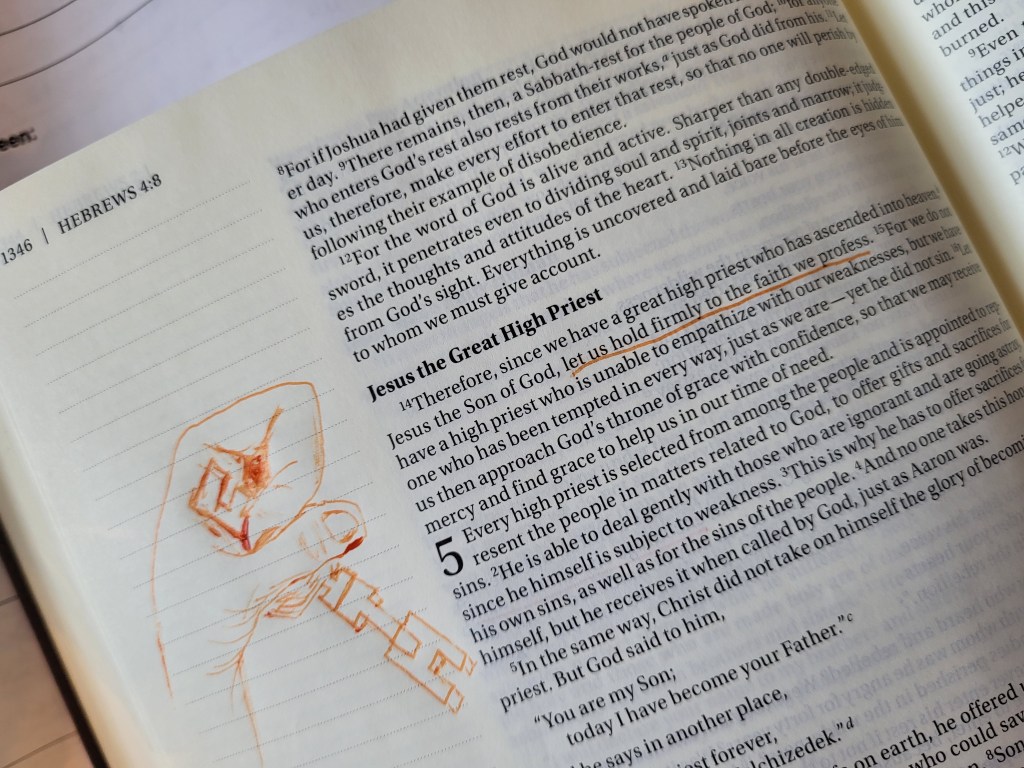
I also showed them an example of the many Bible’s these days that make space for Illumination within them these days.

This is an example of one that I have that I embellish periodically. Notice the nice wide margins.

Illuminating the text not only gives us an opportunity to get to remember the text better, but it also helps us understand it more deeply. In order to add to it, you have to listen to it with your heart first.

At the end of our time, which many of us agreed wasn’t a long enough time – some of these meditative activities you could engage in for hours, we shared our creations in the state they were in in the moment and reflected on the process.

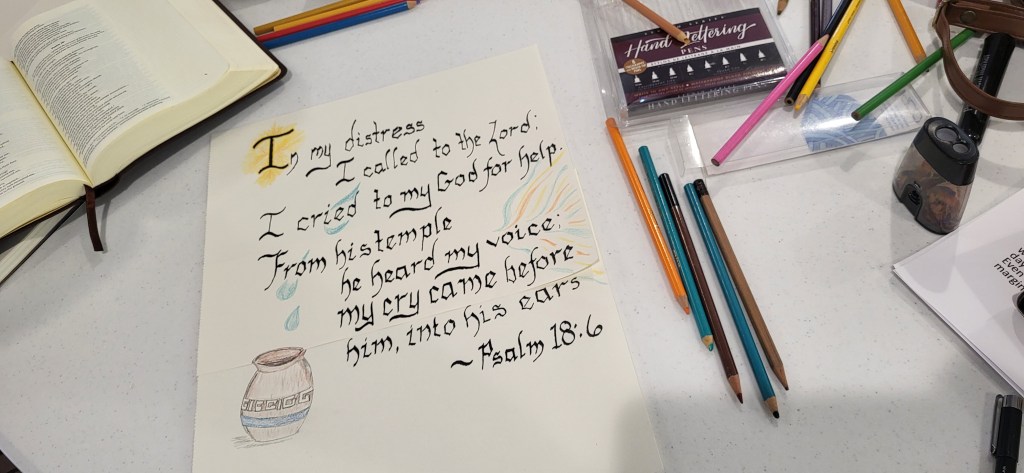
Here are some examples of what people created.

Remember with all of these meditative art processes, it is not the product that matters. It is the process. Enjoy! I look forward to seeing what you create or hearing about your own Illuminating workshop.

A fun confirmation activity

This week we had the second of of our confirmation classes. This time we focused on Jesus. In each class, I’m trying to teach them a spiritual practice, engage them in actually reading the Bible, and connect Christian living into their everyday life.

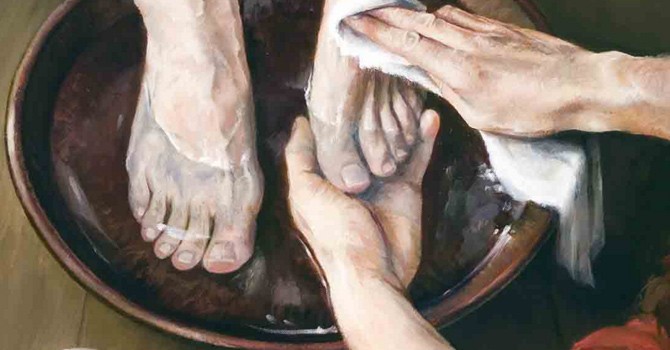
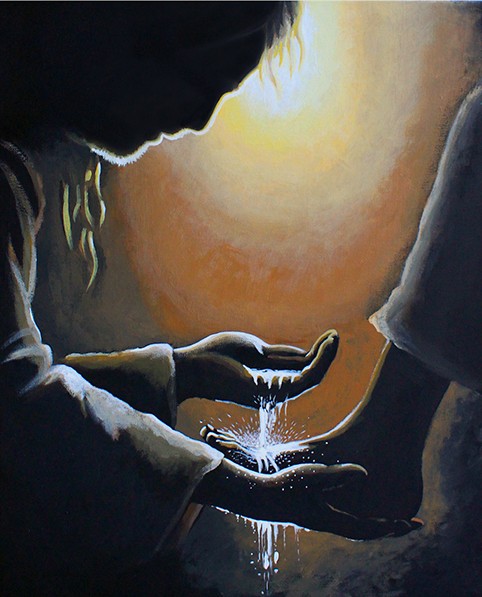
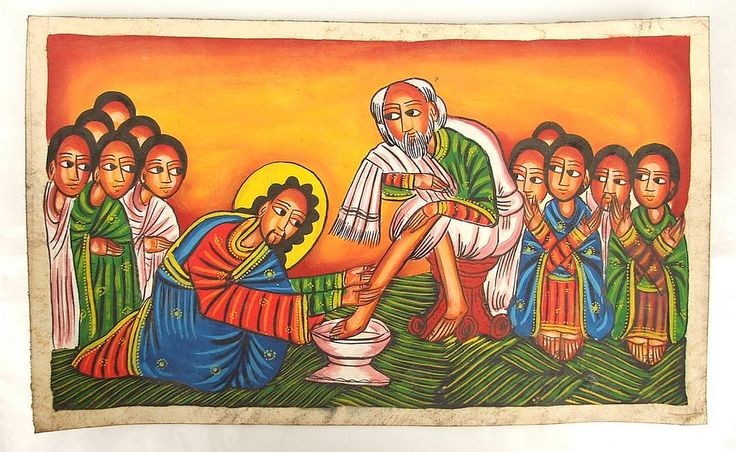
So this week we started with a visio divina from Jesus washing a disciples feet. I had them look at three different pictures for three minutes each in silence and then talk about what they liked and found compelling.

You could no doubt pick any few pictures, but I appreciated how this scaled outward and showed something I suspected that they were at least somewhat familiar with. After sharing our reflections, we talked about how this action revealed a bit about Jesus’ view on leadership and then read Mark 2:23-28 which led to again a question about Jesus’ leadership style and general theology.

At this point, the kids needed a little fun, so we began a competitive sword drill. Sword drills are not too common in my experience of my progressive Christian arena, but I do think it can be used as a fun way to get to know the Bible. Since this is a relatively new church to me and I wasn’t sure about the kids familiarity with the Biblical text I limited our scope to just the gospels. Doing so also gave me permission to offer some vocabulary like gospel and synoptic. I was even able to talk a little bit about the potentially lost source of Q (Quelle) and the theory of when each book was potentially written.

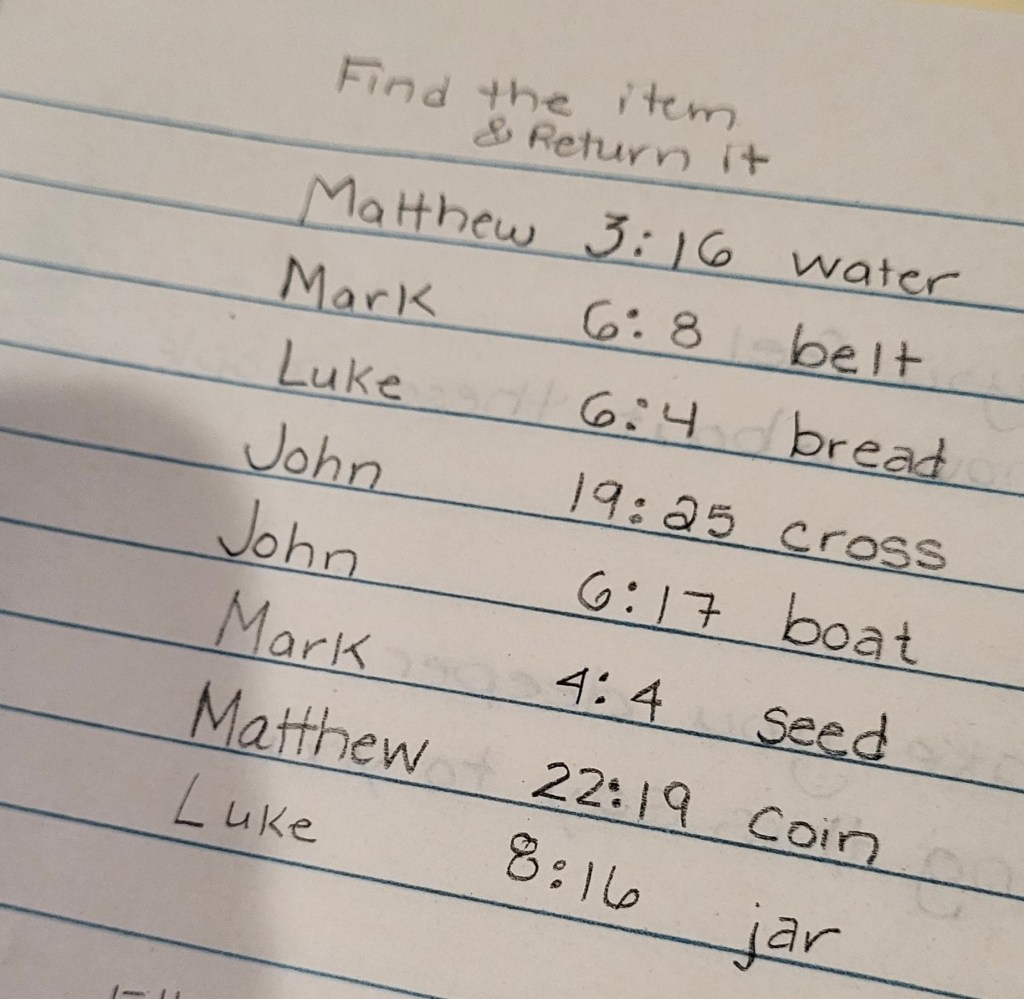
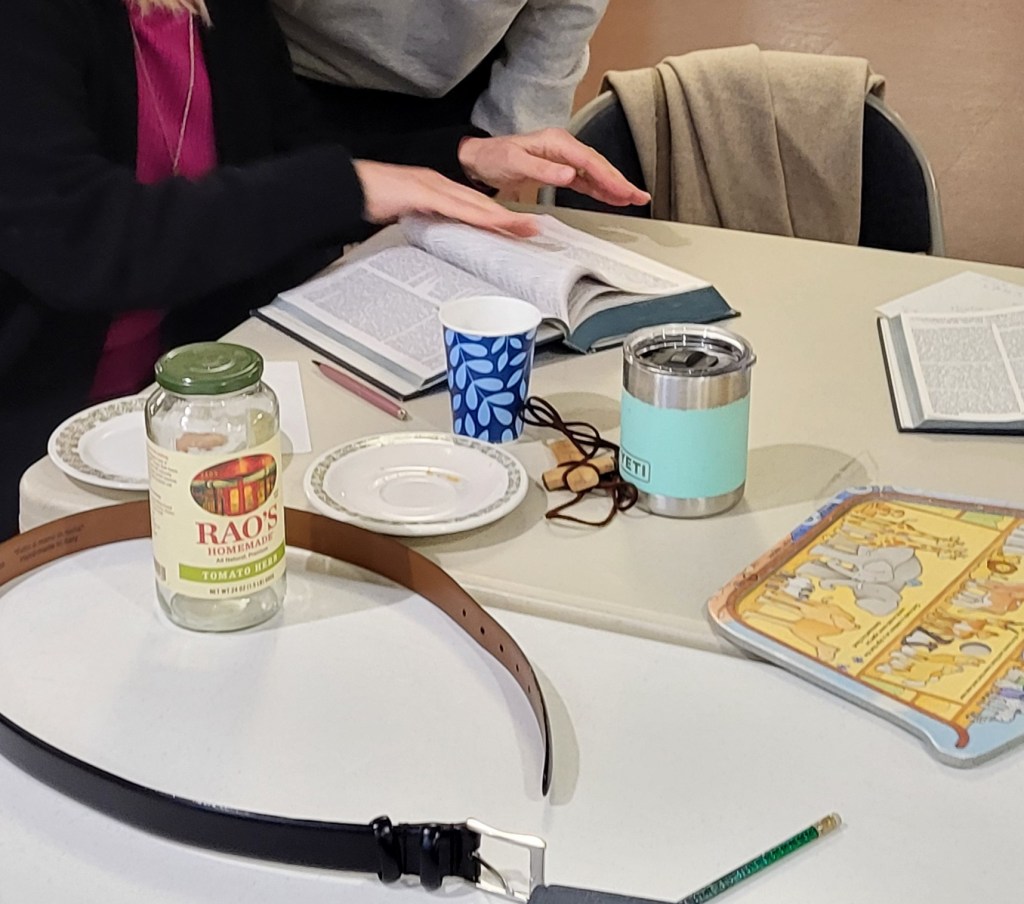
The idea of the game is to have a prewritten list of scriptures for the teams to find. When they find the scripture, the scripture will name an item that you have placed some distance away from them. They have to go find the item and return it before the other. Here is the list that I created:

BE FOREWARNED – – -I learned that I had overlooked that in the Mark 6:8 scripture there is actually a belt and bread. On the positive, the scripture says no bread, but yes a belt. So you could argue the need for a more careful reading. In may case, I accepted both answers.

Also note, that to make this even more fun, we set the kids up in competition with the parents. If you are wondering who won, the kids crushed it.

Following the game, we moved into some ethical case studies and instead of trying to devise solutions, we tried to come up with questions Jesus might ask of the situation or himself to decide what the next best step was. (The case studies were borrowed from Goodcharacter.com )

The whole class was only 90 minutes, and I dare say they even enjoyed it a bit.

Art can open your heart for God

I have found that art is a great way to shut down the noise of life and settle into the arms of God. Recently, I’ve been using art as a way to help others do the same. In my new church setting, I am offering my second series of mid-week meditations. Our first meeting was this morning when we found our center by doodling.

It is funny that when we are young, teachers and others try to get us to stop doodling. “Pay attention. Don’t doodle.” “Why are you just doodling? Draw something real.” As adults though, we need to recapture the freeness of doodling.

Doodling has been associated with all sorts of benefits: everything from improved concentration to better memory, from calmer disposition to reduced cortisol levels. Artistic skill is not a necessity and there is a benefit to its repetitiveness. So doodle, doodle, doodle all day long.

Doodling isn’t as much about the art as it is about the state that you are able to bring your mind into. Different people have different reactions to it based on the mood that they are in, but in general doodling helps us open our heart and quiet our mind. In that state we become more receptive to God.

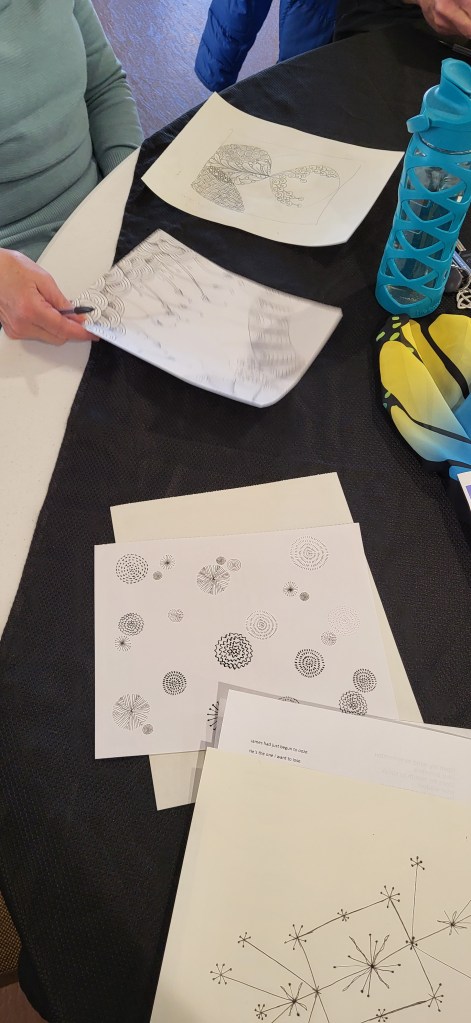
Today, I shared this practice with several congregants. The workshop was an hour long. We began with a prayer and read a poem. Then for 15 minutes we worked off of a preset doodle to warm up and get used to the process. At the end of the 15 minutes, we reflected on the process and continued on to read another poem. Then we moved to the “scary” idea of a blank sheet of paper. Where participants had another 10 minutes to draw from scratch.

Different people find their connection with God in different ways. For some, they sit in silence. For others, they prefer to pray or sing. These are all ways that we have acknowledged and are included in most worship services. Less accepted are movement and art, but they are also legitimate ways to center ourselves.

May we all be willing to experiment with how we can best hear God speak to our heart.

Resources:

Open my mind to remember
your presence.
Open my mouth to speak
your wisdom.
Open my heart to extend
your love.
Open my hands to serve
you generously.
Open my whole being
to you.

-Joyce Rupp


https://mindfulartstudio.com/art-journaling-for-healing-doodle-and-de-stress/

https://svmoa.org/taxonomy/term/48

We specifically use A.A. Milne’s poem and the one by Dan Albergotti. There was no drinking except water and tea.

Have fun and Enjoy!

May you quiet your mind enough to hear God in your life.

Here was our first Mid-Week Meditation series which was based on spiritual practices. Our next series will be the writing edition where we will focus on the written word.