Impermanence

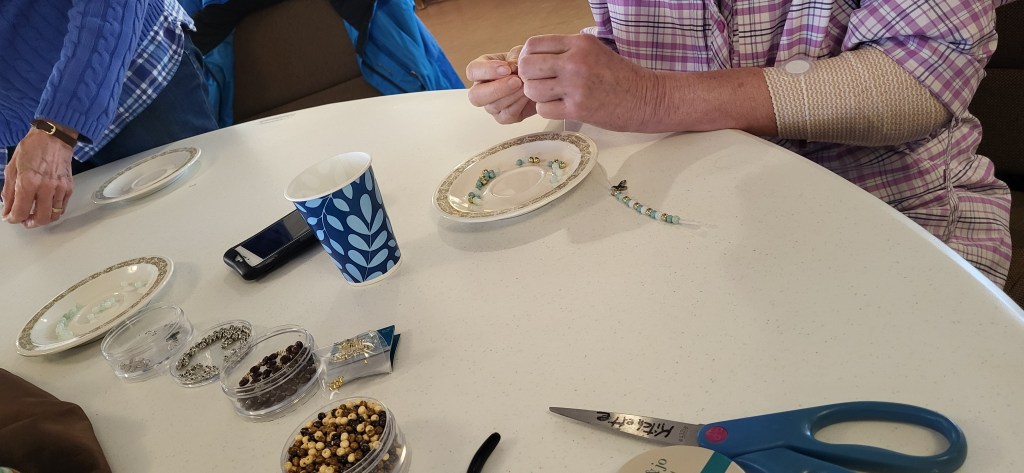
Today in our mid-week meditation group we made prayer bracelets.
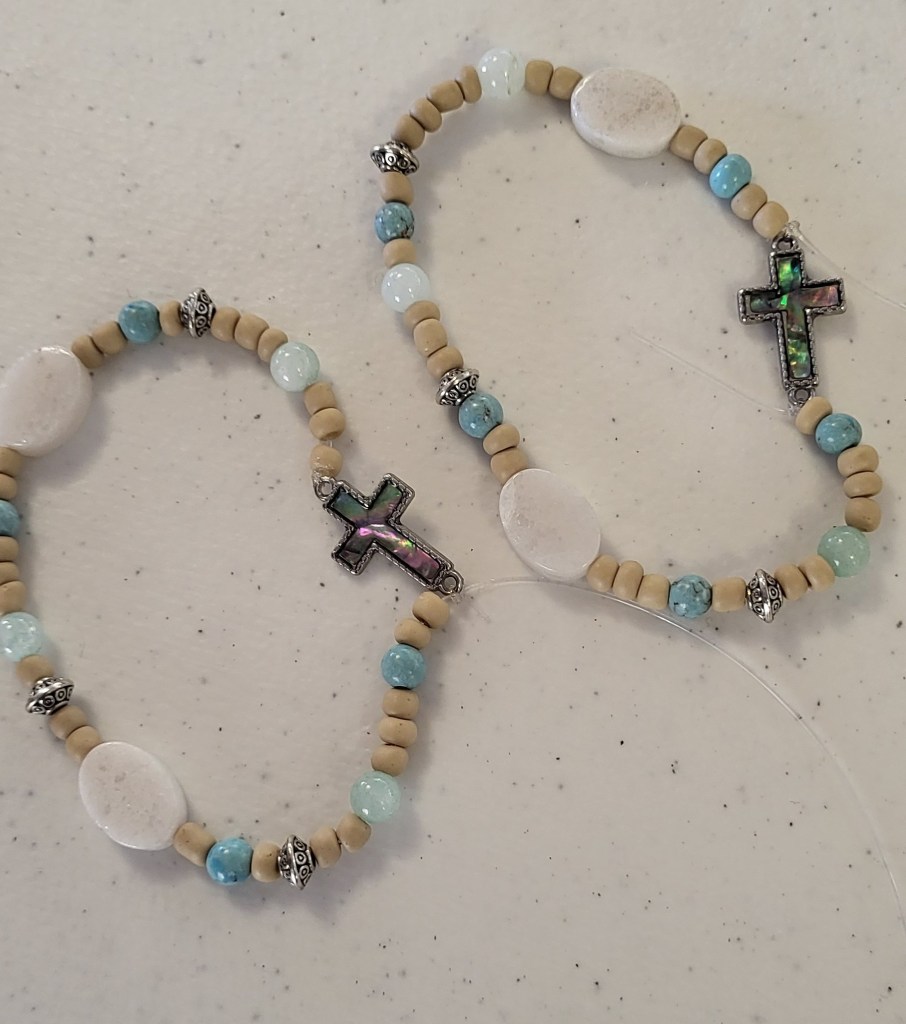
The process was gift and the reminder I found in prepping for the class was worthy.

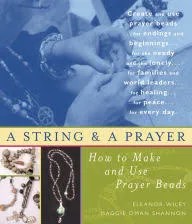
A while ago, I found this book “A String and A Prayer” on my bookshelf and began reading it in preparation for this class. I used some of the prayers in the back as our opening and shared some of its insights during our class:
-The word bead is an offshoot from its Old English origin “bede” which means prayer.

-In Sanskrit the name of a pray bead chain is called a mala.

-That the practice of putting together prayer beads can be a spiritually significant as the practice of praying with them.

-It is said the the Desert Mothers and Fathers would carry a specified number of beads in their pockets with they would drop to the earth throughout the course of their day as they prayed.

And then finally –

-All prayer bead jewelry will eventually fall apart.
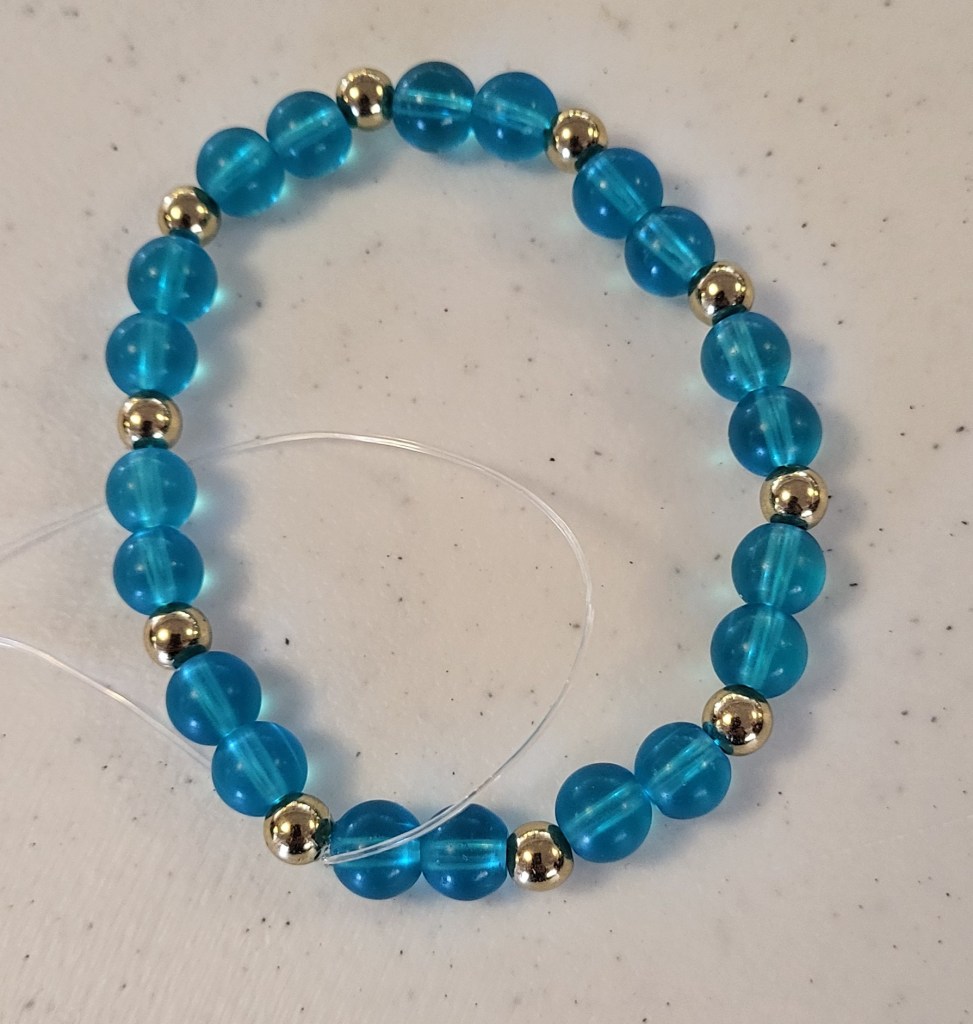
This final one sounds depressing, but it is real. It perhaps struck me especially funny because at our our last confirmation meeting when we created the Protestant equivalent to prayer bead rosaries (which by the way are named such because the beads were apparently made out of crushed rose petals) we worked very hard at crimping and trying to secure our creations so that they would be indestructible. Impermanence is not something that we like to think about much. In Christianity, with the exception of Ash Wednesday and perhaps Good Friday, we have a tendency to focus on the eternal and ever-lasting, brushing aside the reality that life here is guaranteed to end. Perhaps though, the reality of our relatively short mortals lives and the reality of our impermanence might be a gift that might allow us to more fully stop and take in the world around us, celebrating the beauty and appreciating the relationships. Recognizing our impermanence may not be a morbid thought that freezes us in fear, but instead a freeing realization that allows us to better notice the many blessings that abound.

Whether or not you choose to create a prayer bracelet yourself, I hope that you might ponder their impermanence and yours as well. Your life may be all the richer having done so.

A Prayer of Gratitude for the Limitedness of our Lives

Holy One,

We are thankful for this time you have granted us on earth. Let us not waste it, nor take it for granted. Let us have clear view of its limits that we might be all the more thankful for the time we have. Grant us the insight that each breath we take is a blessing.

And when at last our time is short and we can feel the true fragility of life coming our way, let us be able to say that we were thankful for the opportunity, that we were thankful for the friends that we met, and that we were thankful for the time we had.

We give you thanks for each breath, each moment, and for our very life however long or short it might be. AMEN


NOTE: All rights reserved. Permission of use of the prayer in a worship or educational setting with citation.
It takes a long time to create Bethlehem

This week’s mid-week meditation led to a powerful insight:

it takes a long time to create Bethlehem.

There is so much going on in the world, it came seem like a frivolous waste to gather and simply create art, but I have found this creative time to, in fact, be more important than ever. It is in these peaceful settings that we can take a moment to take stock of all that we have seen and heard and begin to try to understand our place and our calling within it all.

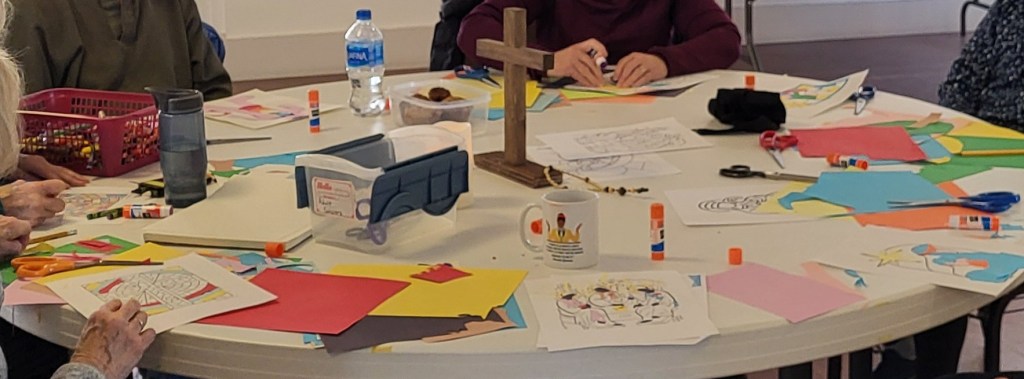
This week, when we gathered, our theme was mosaics. Given our time frame, we created our mosaics with paper, and I limited our paper to just solid colors. I offered the option of some pre-drawn blackline masters that I gathered from the internet and also had plain paper available. I tried to give people as little direction as possible because, like in each of our other weeks, the purpose is the reflection on our thoughts and the process more than the product that is produced.

People always find our time too short and these activities could easily be done on retreat in multi-hour blocks.

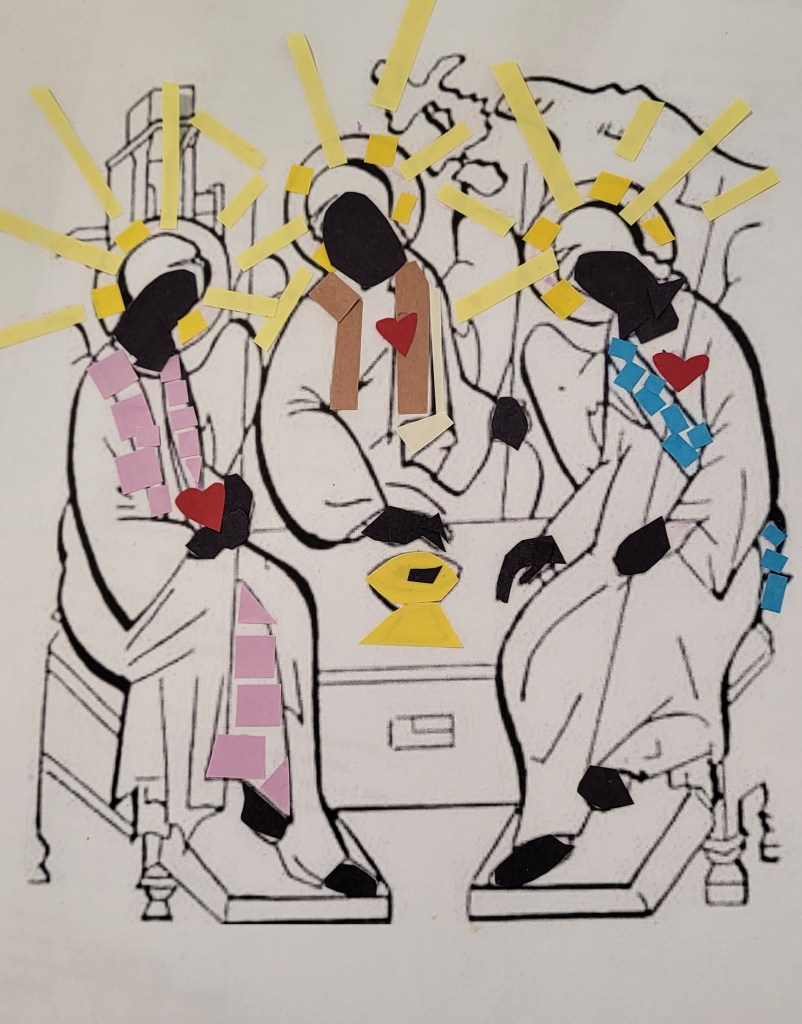
This was my creation based on Rublev’s picture of The Trinity. I was really caught by the idea that each of us have the capacity to be part of the trinity; thus the non-identification of the personalities. I also recognized how we need to be mindful of how we interact with one another. Even with our best intentions we sometimes press into each other’s space.

To help us be in the right mindset to create, we began our time together by putting our hands in the form of a bowl and filling our bowls with all the dread, frustration, anger, and worry that we brought in with us. After gathering it together in our own imaginary bowls, we placed the bowls below the cross in the center of the table and agreed that if stressful thoughts came our way we would give them over God through a symbolic gesture of hanging our worry on the cross. Once we released the troubles we came in with, we offered a prayer and lit our candle. Then I read a poem called Mosaic by Lily Whitelock (click here to read the whole poem) and offered a quote by Anita Krizzan. We were particularly enamored with the words of Lily’s third verse,

“Every word I know somebody else has told me.

Every smile I give someone else has shared.”

“We are mosaics. Pieces of light, love, history stars . . .Glued together with magic and music and words.

Anita Krizzan

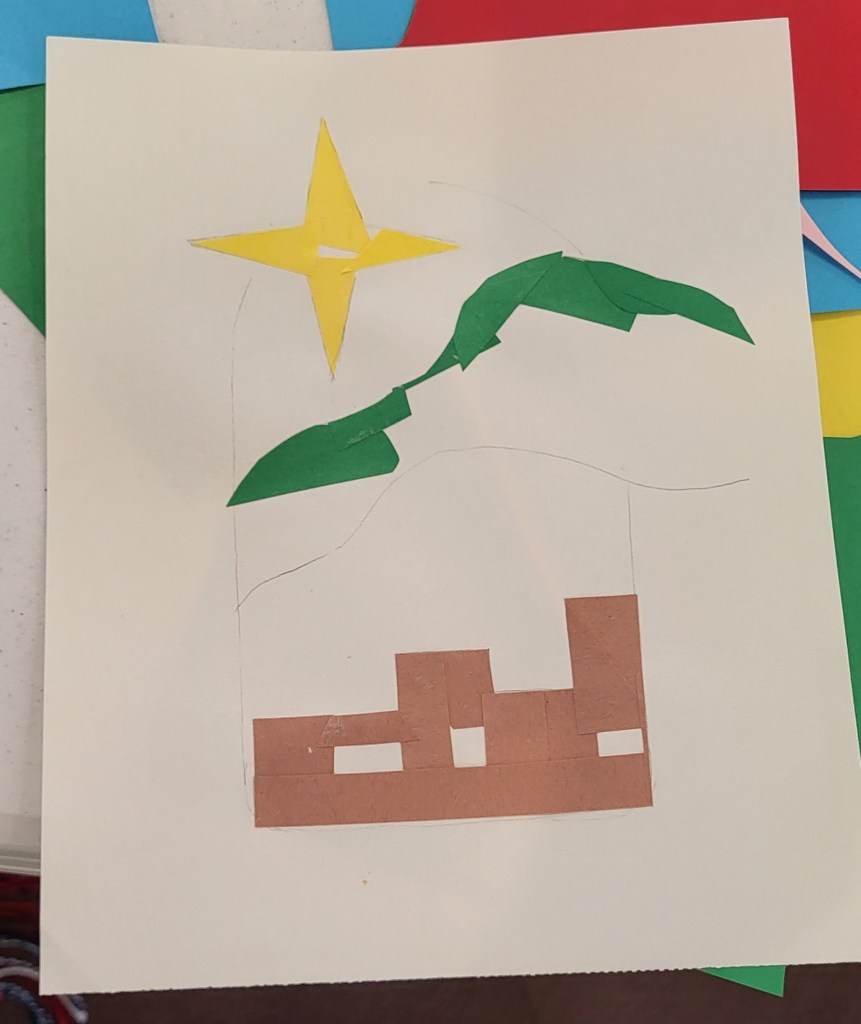
We then created for half an hour, gathering back together to discuss and reflect on the process. There were many insights that individuals had about how they created, what they created, why they created; and there was one that took all our breath away. As one congregant shared this work:

She explained that she didn’t have enough time and would be taking this home to finish. She somewhat flippantly said,

“If you didn’t know, it takes a long time to create Bethlehem.” MC

When she said that, my heart stopped. It was a reminder to us all that within the struggle and frustration that we are all feeling these day, we need to remember that to create takes time, energy, perseverance, patience, and vision especially when your vision is as complicated and simplistic as love, justice, and compassion.

We closed with a simple prayer and all went out into the world with a little more hope and with clearer understandings of where we might fit into the larger picture and how our gifts and talents might be used.

If you decide to try to create, I’d love to see what you make. Please post in the comments.

Holy One, Sometimes challenge comes not in complexity but in simplicity. As your co-creators in life, help us to step back and take stock on that which is essential. Encourage us to release that which gets in the way of your vision of heaven on earth being made real in the world. Call us into partnership with you so that together we might together create a peaceful, loving, and just world. Remind us of the time when your son was born in a simple stable. Let us remember its simplicity and yet also his power to transform the world. May you use us to do the same way. AMEN

Listening to God through art

This week in our Mid-Week Meditation: the Arts Edition we did collage. Most people associate collage to the vision boards that we all made in Jr. High where we pasted pictures from magazines on a board as a way to try to capture our hopes and desires. This session was a little different than that although the basic artistic process of cutting and pasting was the same.

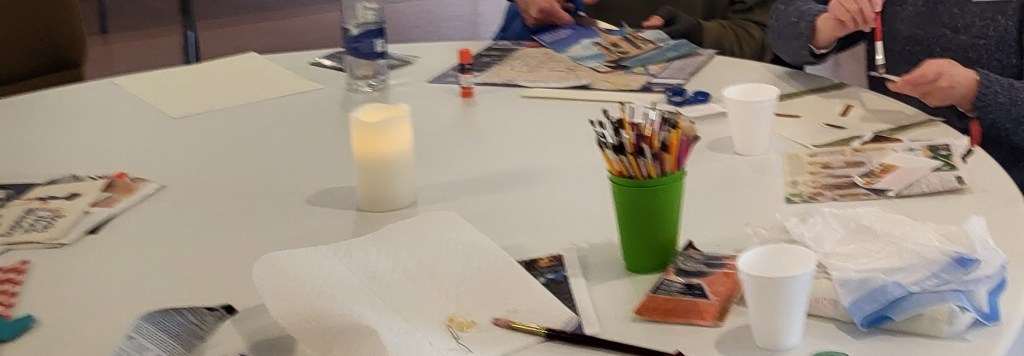
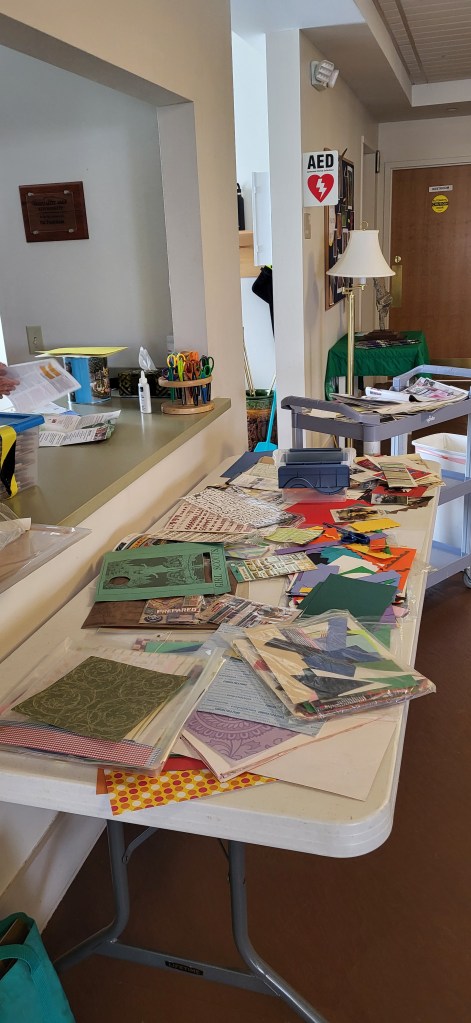
I put out a plethora of materials, but only a few magazines (and the magazines that I read are not very picture oriented). I had glue sticks and created some modge-podge type glue through a 50/50 blend of white glue and water. I had both straight edge and design edge scissors out, but had considered not putting them out so that they would have to rip and tear the materials. I had old maps, bags with designs on them, excess materials from my scrapbooking days, and other odds and ends (I encourage you to trust that what you put out will be enough)

We opened as always with lighting the candle. Then, I then offered three short readings. One a quote from Pablo Picasso about taking a lifetime to create like a child. The second a quote from Rilke about living the questions. Then finally, this passage from Journey of the Universe by Brian Thomas Swimme and Mary Evelyn Tucker:

In a simple but elegant form, awareness appears in unicellular organisms. The capacity for discernment resides in a thin outer layer of each cell, called its membrane. The membrane, through its receptor and hannel protiens, selects what is of interest and what is not, what will enter and what will not. Each cell encounters a wide spectrum of atoms and molecules and otehr ogranisms floating alongside it. Each time the cell makes contact, primitive discernment emerges.

In the vast majority of these interactions, the membrane remains tightly sealed in order to block a novel molecule form its inner life. However, in encounters with molecules of particular configurations, the cell responds very differently. the molecules of the cell’s membrane latch onto this new molecule. The cell then alters the structure of its own membrane so that this molecule can be drawn in. Because of this discernment, the new molecule becomes part of the cell’s internal milieu. In this way the cell finds and captures its “food” – the energetic molecules it can digest.

Discernment is crucial. Mistaken decisions can lead to death because the inner coherence may be broken by the strange new guest-molecule. Thus, at the edge of its body, each cell makes an elemental choice. Is this a risk worth taking? Is this food nourishing? Will this increase the chances of remaining alive?

I then tried to offer as little direction as possible so that those that participated might look deep into their own heart. The two pieces of guidance that I did offer was:

  1. Try to engage. At least, move yourself over to the materials and see what shimmers.
  2. Don’t try to “make” something. Let you mind, heart, and the materials do the creating. Later we will look to see what may have been said through them.

They then got to it. We could have used a much longer expansive time, but due to our limitations and our desire to share about the process and our insights, we only had 30 minutes to create. (One benefit to a shorter period of time is that it encourages quick decisions that rely more on our gut than our mind that often gets high-jacked with judgement.)

When they finished creating, we took 2 minutes to listen to what God and / or our own inner being might be trying to say to us. Then we thanked God for this opportunity to create. We talked about what we learned in the process of creating and then about what we noticed in our own creations.

It was amazing, as always, how different they all looked.

One of the interesting responses that I have been getting from these workshops is how not only are they a place of peace, but that the peace they find in the moment also carries with them throughout the day. I noted that this is important. There is definitely a lot of work to be done in the world AND we must balance that we self-care, time for reflection, and worship. The rhythm between the two becomes sustaining rather than depleting. It also helps us with our discernment about where to put our energy and invites us to think about problems from a more creative perspective. Activist, Attorney, and Author Valerie Kaur likens the balance we should find in life to giving birth. You cannot keep pushing. Periodically, you have to take a breath.

May we each find our balance and in our balance, may we offer the world a more grounded and compassionate perspective.

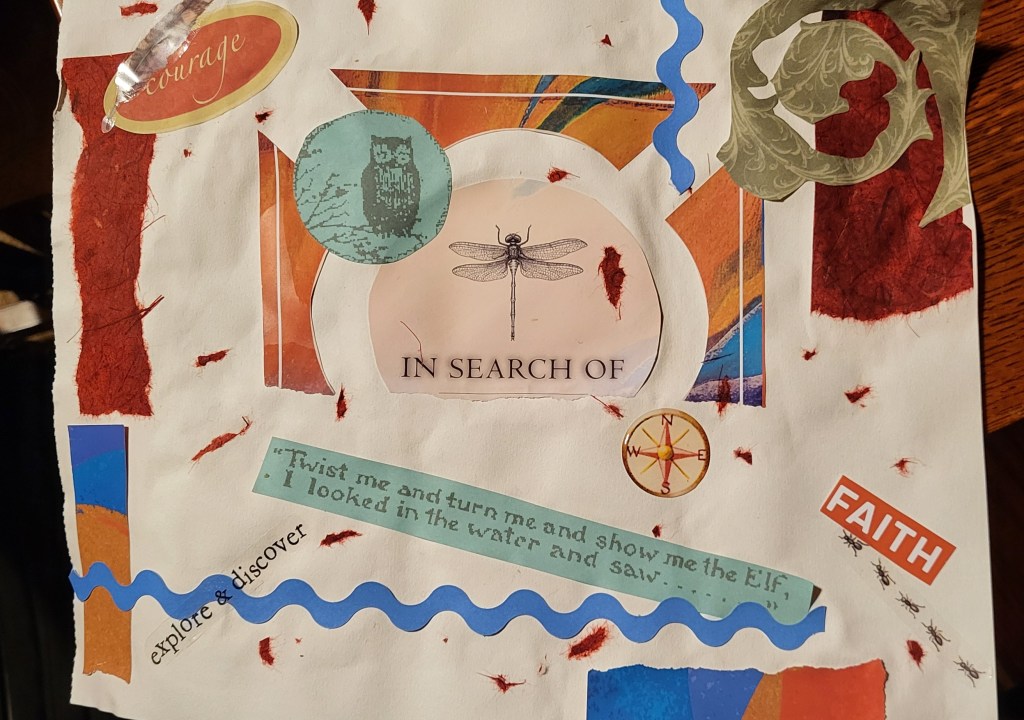
I usually try to create alongside the participants as best I can given the other things I am focusing on. Here is my creation that day.

If you take time to give it a try, I’d love to see what you create.